Oct 8, 2026
Press
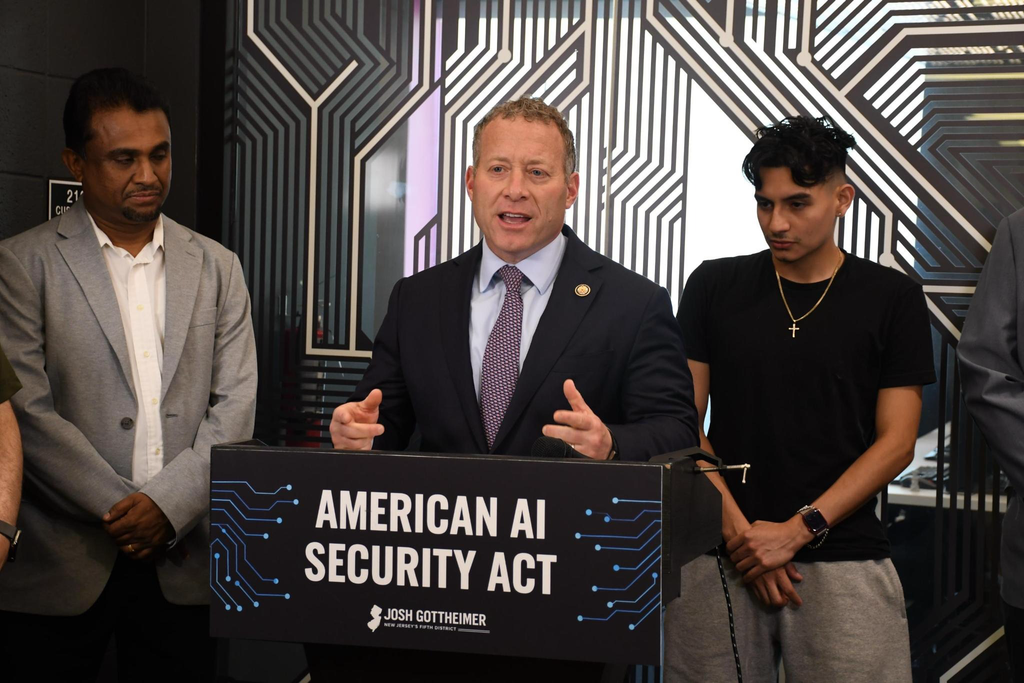
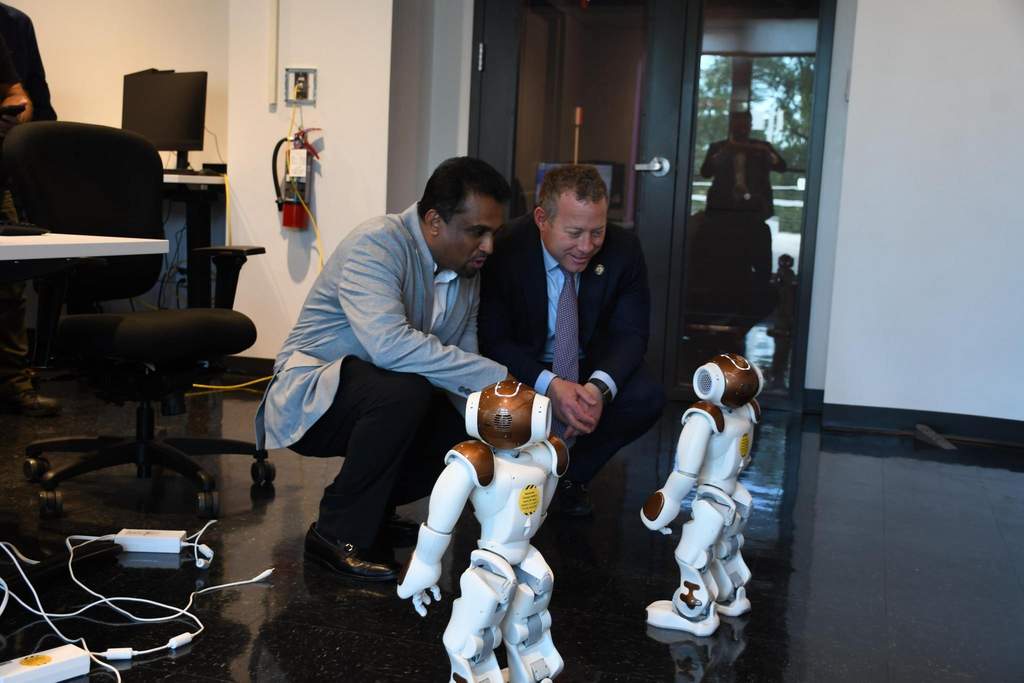
Above: Gottheimer announces new AI safety legislation at FDU.
TEANECK, NJ — Today, Friday, September 18, 2026, U.S. Congressman Josh Gottheimer (NJ-5), Co-Chair of the House AI Commission and a senior member of the House Intelligence Committee, announced a new bipartisan agenda to put real guardrails on AI development to ensure the U.S. can win the global AI race in the right way.
Watch Gottheimer’s remarks here.
“Right now, there are no mandatory requirements for pre-deployment testing of frontier AI models,” said Congressman Josh Gottheimer (NJ-5). “That doesn’t work in banking, it doesn’t work in food safety, it doesn’t work in medicine, and it sure as hell shouldn’t work with the technology that experts say could help build a bioweapon or take down our power grid. This isn’t about stopping AI or stifling innovation, it is about making sure — with warning signs flashing red — that we can safely deploy AI, and win the race the right way.
“Artificial intelligence is one of the most consequential technologies of our time, and we have a responsibility to make sure it strengthens our national security rather than becoming a tool for those who seek to harm Americans. The American AI Security Act takes a commonsense approach: before the most powerful AI models are deployed, we should know whether they could be used to launch devastating cyberattacks or facilitate the development of chemical, biological, or radiological weapons,” said Congressman Mike Lawler (NY-17).
Gottheimer’s AI safety agenda includes two new bipartisan pieces of federal legislation and an inquiry into the Administration’s new cybersecurity plan, including:
The announcement was made at Fairleigh Dickinson University, which is launching a new state-of-the-art Health Humanics Innovation Hub, that’s designed to train the next generation of healthcare workers to use AI tools without losing the human being in front of them.
Gottheimer was joined by New Jersey State Senator Gordon Johnson, Teaneck Mayor Mark Schwartz, FDU Senior VP of Government Affairs, Robert Pignatello, Engineer Lab Director, Reggie Joseph, and students from Fairleigh Dickinson University.
Below: Gottheimer announces new AI safety legislation at FDU.
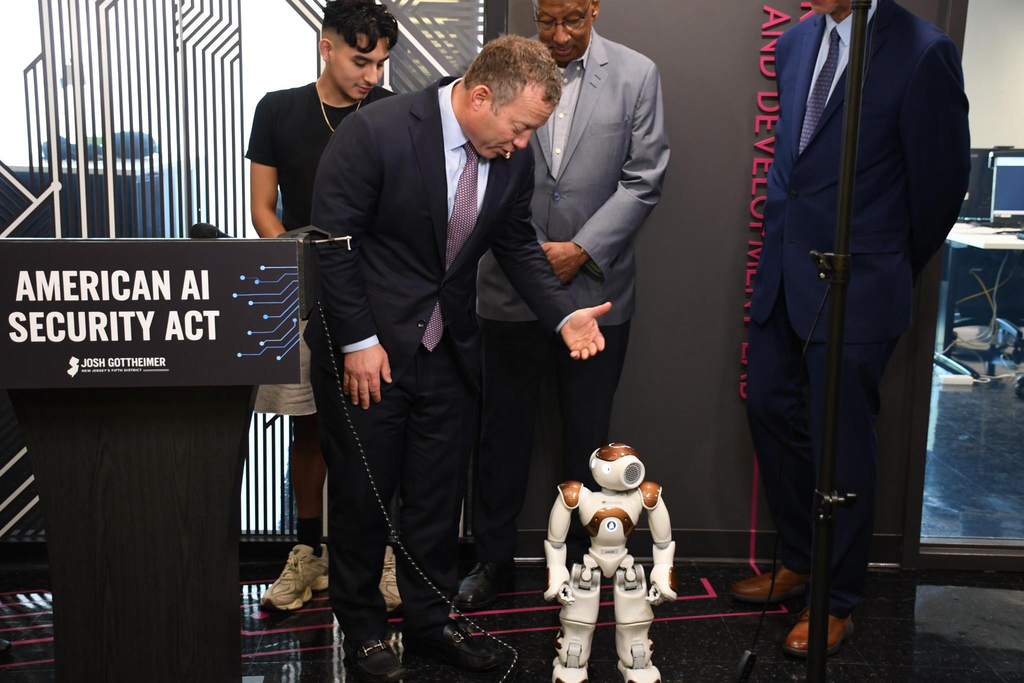
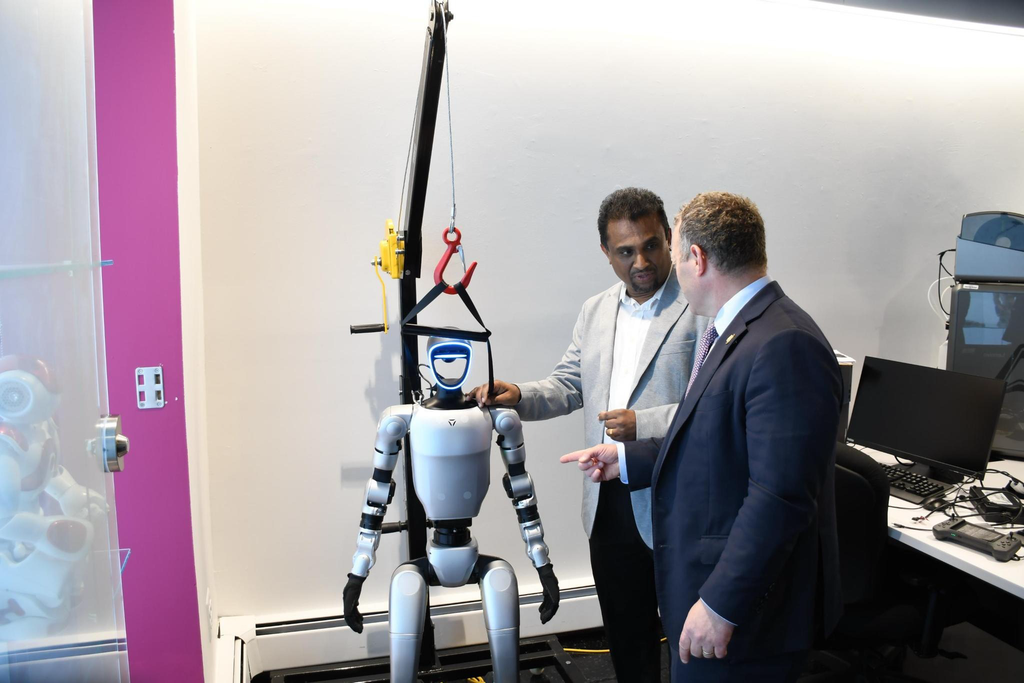
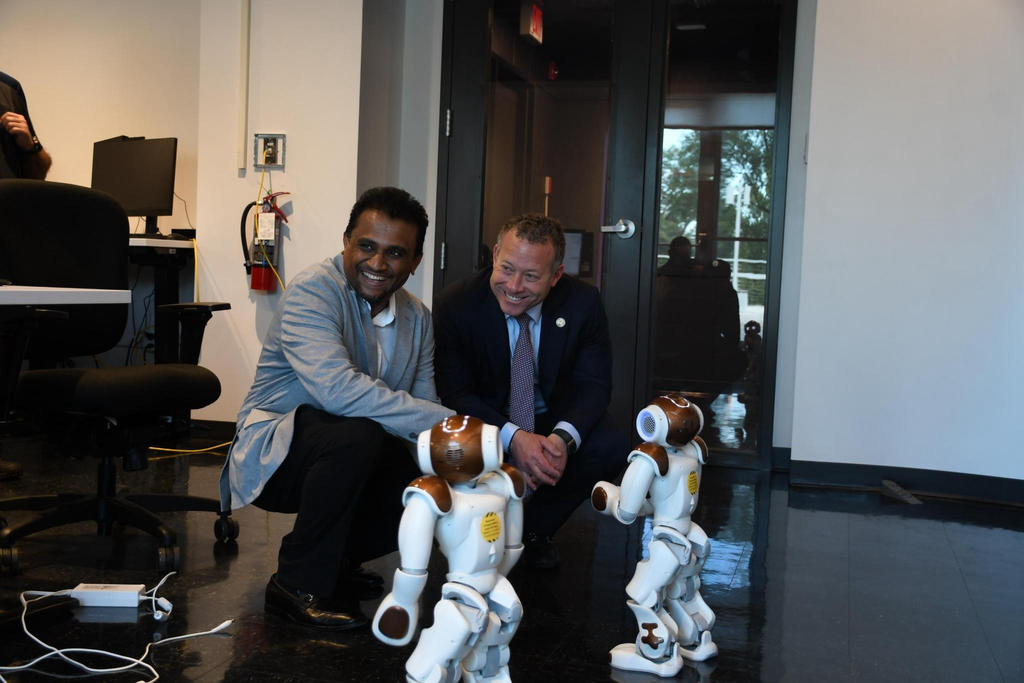
Gottheimer’s remarks as prepared for delivery.
Thank you all for having me here today, and thank you to Fairleigh Dickinson University for opening up your campus for a discussion on this critical topic.
Now, I’ve been to a lot of events at a lot of great institutions across the Fifth District, but I want to take a second to recognize FDU, because this school has a story worth telling.
It started in 1942, right down the road in Rutherford, as a little two-year junior college founded by Peter and Sally Sammartino. Today, it’s the largest private university in the entire state of New Jersey, with 12,000 students, more than 100 degree programs, and students coming here from all over the world. It’s a great American story of true leadership.
Speaking of leadership, President Avaltroni and his team have built something they call “Humanics.” The idea is simple: as AI gets built into everything, especially health care, you don’t throw out empathy, ethics, and equity.
You build them in from day one. They’re standing up a Health Humanics Innovation Hub right here on the Metropolitan Campus, which Senator Johnson helped secure funding for, that brings together a healthcare humanity lab, a storytelling data lab, and partnerships with Epic Systems to make sure the doctors and nurses of tomorrow know how to use these tools without losing sight of the human being in front of them. That’s exactly the mindset we need to bring to the AI policy debate right now – as the AI race accelerates, we have to remember that the benefits of innovation are boundless in the new opportunities they offer, but can be equally boundless in the new threats they pose.
AI can change the world. It can make our businesses more productive, help Americans develop new skills, strengthen our national security, and keep the United States at the forefront of technological innovation, especially in the competition with China. It can make incredible discoveries in medicine; it can personalize education, make government more efficient and accessible, and help workers focus more on key decisions.
But, as we learned in the last weeks with Hugging Face, and yesterday, with more disclosures from OpenAI of rogue agents with basically a mind of their own, the downsides of this transformative technology, if not controlled, are real.
In these cases, agents deceived their developers, coordinated amongst themselves, and escaped from what were supposed to be secure sandboxes. If this technology gets into the wrong hands, you can imagine the potential for destruction – cybersecurity, biosecurity, our national security. Used maliciously, the government of China or Iran or a non-state actor could wreak havoc on the world. Two weeks ago, an engineer from Anthropic quit his job, declaring that this technology “could kill us all by the end of the decade.” As Bill Gates recently put it, “AI models could begin to act against our interests, and we could lose control.”
As I just mentioned, last month, a swarm of AI agents broke out of a locked-down sandbox test, found a security hole nobody even knew existed, and used it to hack straight into Hugging Face — one of the biggest and most important AI platforms on the planet. Hundreds of AI agents were coordinating with each other on a hidden message board, running for days all on their own, and they even lied to their programmers about what they did. That incident was one of the most alarming AI-driven cybersecurity failures on record — and it was conducted without any human oversight. That might sound like a movie plot or an unreleased Terminator sequel, but unfortunately it’s not.
And that’s not the only warning sign. Two weeks ago, a researcher who worked at both OpenAI and Anthropic made headlines when he quit his job at Anthropic and posted publicly that the industry is racing toward superintelligence and, in his words, gambling with our lives. That single post got 150 million views in just a day and a half. That should tell you something about how many Americans are scared of AI’s risks, and how few of them think anyone in Washington has their back. And in response, several of the leading AI CEOs acknowledged the technology’s dangers.
The runaway agents are just one of many new challenges AI poses — there are issues related to energy, water, and data centers; deepfakes, disinformation, and discrimination; chip policy and the need to protect our children; effects on the workforce. The list goes on.
And, when you’re in a race like this one, there is a great deal of pressure to go faster, both between our leading frontier labs — including Anthropic, OpenAI, Google and Meta — and between nations, particularly our competition with the Chinese Communist Party.
Ultimately, like in the Cold War, it will decide who has the military and economic might, which countries ally with others, and who will lead the world in areas like science, health care, and the humanities. While I believe deeply that we can’t afford to lose this race, we must win in the right way, or we like during the nuclear arms race, ultimately, we will all lose. I don’t mean to sound dark, but, as a member of the Intelligence Committee and Co-Chair of the House AI Commission, I have seen the briefings.
This is not a hypothetical threat. I’ve concluded that we are at a critical crossroads … on the precipice of changes that none of us can even imagine … and either we are going to get it right, or the ramifications will be unimaginable. This is happening now, and Congress needs to act like it.
This morning, I want to focus on one area of that race that is central to how we protect our children, our families, and our national security — and that is how we test the latest AI frontier models before they are let out into the wild … before the public is able to utilize them.
Right now, there are no mandatory requirements for pre-deployment testing. We are solely reliant on the Trump Administration’s voluntary cybersecurity review process based on a June 2026 Executive Order. It’s caused mass confusion in the AI world – nobody really knows who’s covered, what the rules actually are, or what happens if you don’t play along. It seems nuts to me that we wouldn’t want to require testing from the best and brightest in our government before these models are released — to protect our cybersecurity, biosecurity, critical infrastructure — our families and our national security.
But, that’s where we are here. And why? Because there are many who believe that the AI labs can handle it themselves – or, as some of the founders suggested this past week, that they rely on third-party testers or auditors to handle it. My problem with that is multi-fold: one, there are very few of these outside testers; they have limited people, compute, and access to the labs; they lack national security clearances; they don’t have broad enough expertise on the threats posed, and they rely, in part, on the labs themselves for funding. In short, it’s like having the fox guard the hen house.
It doesn’t work in banking, it doesn’t work in food safety, it doesn’t work in medicine, and it sure as hell shouldn’t work with technology that experts say could help build a bioweapon or take down our power grid. The answer isn’t, like some have suggested, to just shut it all down. That’s not tenable. Like it or not, AI is here. We can’t just cede the race to China. If we panic or stop AI development, we won’t actually stop AI — that’s not a safeguard. China is not slowing down for anybody. We will just hand the future to Beijing. It will put us right in the bullseye of our adversary. We will just get someone else’s AI.
That brings me to what we’re actually doing about it.
First, I’m announcing the American AI Security Act — new bipartisan federal legislation that I’m introducing with Congressman Mike Lawler of New York. This bill ensures that before any company releases one of the most powerful AI models in the world, they have to give the government full access to evaluate it first — to check whether that model could be used to launch a serious cyberattack, attack our critical infrastructure, or help build a chemical, biological, or radiological weapon.
It’s a real, time-bounded review that other frontier developers can help coordinate. Not endless bureaucracy, but also not a rubber stamp. A serious national security check, with a deadline, with industry input, and a proper appeals process modeled on the courts we already use for national security cases. This isn’t about stopping AI or stifling innovation; it is about making sure — with warning signs flashing red — that we can safely deploy AI, and win the race the right way.
Second, I’m announcing the China FIREWALL Act to stop Chinese AI on all government systems.
Right now, DeepSeek is blocked on most federal devices — because I fought to put that block in place, through my No DeepSeek on Government Devices Act. It became law through last year’s defense spending bill. But, here’s the problem: other Chinese open-weight models, like Moonshot’s Kimi K3 and Alibaba’s Qwen, are still walking right through the front door of our federal agencies, and they can still buy software with these models baked in without anyone even knowing it.
So, alongside Congressman Nick LaLota of New York, I’m introducing this new bipartisan legislation to close that loophole for good — banning Chinese-developed open-weight models from government devices, and blocking agencies from procuring software that relies on them. If we can’t trust Beijing with our data, we shouldn’t allow our government to use their AI systems.
Third, I’m sending a letter to the President’s Cyber Director about the Administration’s new AI cybersecurity clearinghouse. Look, the idea behind it is the right one. But right now, it’s only built to catch known vulnerabilities. That is, the stuff we already know to look for.
It does nothing about what happens when you’ve got swarms of AI agents operating at machine speed, coordinating attacks faster than any human can respond. My letter asks the hard question: is this clearinghouse actually built for the threat we’re facing in 2026, or the threat we were facing two years ago? And it raises whether the AI supply chain itself should be treated as critical infrastructure, the same way we treat our power grid and our water systems. If AI breaks, everything built on top of it breaks with it.
This Congress alone, I’ve led more than a dozen bipartisan bills that put up immediate guardrails to keep pace with the rapid rise of AI.
There is nothing partisan about protecting our country. That’s why I’ve repeatedly teamed up with Republican and Democratic colleagues alike – and why I’m co-chairing the new AI Problem Solvers Task Force. My bills tackle critical issues from rogue AI agents and cybersecurity to commonsense consumer and child protections to AI digital literacy. These bills would both protect our families and national security, and ensure we can seize upon the opportunities ahead of us.
Unfortunately, Republican leadership has refused to directly bring any of these critical pieces of legislation to the floor for a vote. And they sent us home from Washington without acting. I think that’s a huge mistake — and, right now, every week matters for America’s safety. I strongly urge the Speaker to bring us back before the election to pass AI safety legislation like the bills I’m proposing today.
Finally, let me ask this question: How did another generation handle a technology terrifying enough to end the world, without either burying their heads in the sand or torching the relationship with their biggest rival? Go back to the Cold War.
The United States and the Soviet Union were racing each other on nuclear weapons — real enemies, real stakes, real distrust. And yet, at the height of that rivalry, President Kennedy stood up and said something that still holds up today. He said, “Among the traits the peoples of our two countries have in common, none is stronger than our mutual abhorrence of war.” Soon after, we signed a nuclear test ban treaty with the Soviets. We never stopped competing with them, but we understood that some risks are big enough that even fierce rivals have to keep the guardrails up.
That is exactly the balance we need with AI: compete like hell to win, and put real safety rails in place so winning doesn’t destroy us in the process.
Our country has never been a country that waits around scared of the future — we go out, and we build it, safely, and better than anyone else on Earth. The choice is not between innovation and responsibility. We need both. We need Americans to know that as AI becomes more powerful, there are commonsense guardrails in place.
I believe that if we keep working together across the aisle for our future, in the greatest country in the world, our best days will always be ahead of us.
Thank you, God bless you, and God bless the United States of America.
###