Oct 16, 2026
Uncategorized
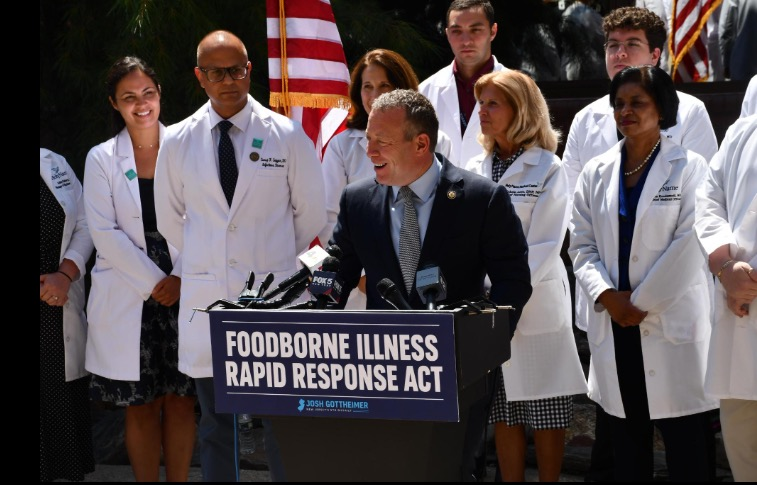
Above: Gottheimer announces Foodborne Illness Rapid Response Act at Holy Name Medical Center.
TEANECK, N.J. — Today, Monday, July 20, 2026, at Holy Name Medical Center, Congressman Josh Gottheimer (NJ-5) announced new bipartisan federal actions and legislation to combat the ongoing, record-breaking Cyclospora outbreak.
Watch Gottheimer’s full remarks here.
The bipartisan “Foodborne Illness Rapid Response Act” with Rep. Don Bacon (NE-2) will:
Currently, there are nearly 7,000 reported Cyclospora cases and more than 140 hospitalizations across at least 34 states. This is an alarming 2,700 percent increase from the roughly 249 cases reported nationally at this time last year. New Jersey’s Department of Health has logged more than 45 cases so far, with numbers expected to continue climbing. Continued uncertainty about the source of the outbreak underscores the need for stronger federal food-safety surveillance and outbreak response. No cases have been traced to Jersey-grown produce, though Gottheimer said New Jersey farmers are seeing sales drop as consumers grow wary of produce in general.
“I have two children, and like every parent in New Jersey, I want to know that when my family stops for lunch, has a barbecue, or grabs tacos on a Tuesday night, or picks up a bag of salad, that the food is safe. That no one will get sick, ” said Congressman Josh Gottheimer (NJ-5). “Right now, with what’s going on with Cyclospora, I can’t tell you with a straight face that it’s a guarantee. That’s a real concern for Jersey families, and I get it. We must do everything we can to take it on so that you don’t have to worry if your food is safe to eat.”
“Families should be able to trust that the food they buy at the grocery store or order at a restaurant is safe,” said Rep. Bacon. “When foodborne illness outbreaks occur, federal, state and local officials need the staff, data and coordination necessary to identify the source quickly and protect the public. I’m glad to work with Rep. Gottheimer on the bipartisan Foodborne Illness Rapid Response Act to strengthen food-safety surveillance and improve our response to outbreaks like Cyclospora.”
At the event, Gottheimer outlined three actions:
The outbreak has been made worse by cuts to federal public health agencies. The CDC is the nation’s first line of defense against foodborne disease outbreaks. When people get sick, the CDC works to detect these outbreaks, identify the culprit, and alert the public. That information is what then enables the FDA to trace contaminated food through the supply chain, identify the source, and quickly remove unsafe products from the market before more families get sick.
Since 2025, the CDC has fired more than 2,800 staff members – roughly a quarter of the agency – including a more than 70 percent reduction in the CDC’s parasite surveillance team responsible for tracking Cyclospora and other pathogens. The FDA has also fired more than 4,300 people.
In July 2025, the CDC also quietly downgraded Cyclospora and five other pathogens from mandatory to “optional” tracking, meaning health officials are no longer required to actively monitor and report Cyclospora cases in the same way they were for almost 30 years. Additionally, HHS has canceled 444 CDC grants worth $5.78 billion. These cuts flow right down to underfunded state and local health departments, which rely on the CDC for roughly 80 percent of their domestic public health funding.
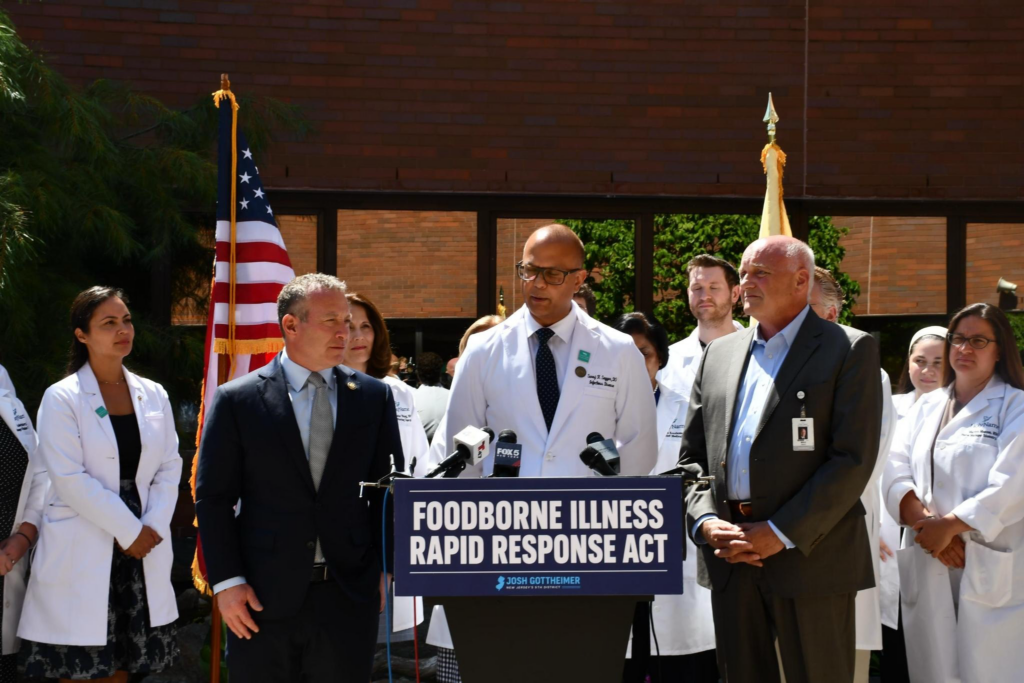
Gottheimer was joined by Mike Maron, President & CEO of Holy Name; Dr. Suraj Saggar, Holy Name’s Chief of Infectious Diseases; Dr. Vasantha Kondamudi, Holy Name’s Chief Medical Officer; and Teaneck Deputy Mayor Karen Orgen.
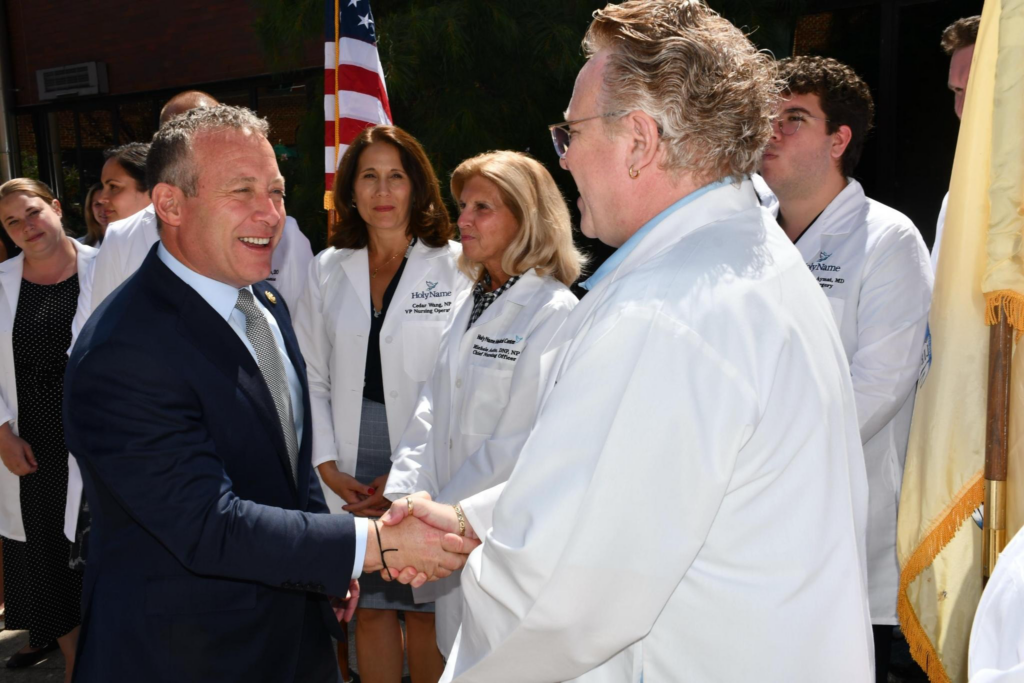
Below: Gottheimer announces Foodborne Illness Rapid Response Act at Holy Name Medical Center.
Remarks as prepared for delivery below:
Good morning. Before I get to the topic at hand, I’d like to comment on Friday’s Third Circuit Court ruling, which significantly set back gun safety in New Jersey and our country. The Circuit Court overturned our State’s ban on extended or high-capacity magazines and AR-15s, which are weapons of war. I have no problem with folks who know what they’re doing from hunting or protecting themselves.
But, there’s no need for military-style weapons and high-capacity magazines — to me, after speaking to friends in the military and law enforcement, if you need that much firepower in the suburbs, the city, or on the farm, it just means you’re a bad shot. This should be settled law. Americans want background checks, people who carry to be trained, and they don’t want Uzis on their streets. We will do everything we can in the halls of Congress and in the courts to fight back and protect our families.
Onto some better news and some other explosive news … Congratulations to Spain and to New Jersey — and MetLife — for proving that no one hosts better than we do. Thanks to Holy Name Hospital for hosting us today. It’s great to be back at one of New Jersey’s best hospitals. Aside from providing top-notch care, with the best doctors, nurses, and EMTs around, Holy Name has been recognized by NJBIZ as one of the “Best Places to Work in New Jersey” every year since 2006. Yes, since 2006. And when you visit — like I have many times — you can truly see why.
We are here at this great hospital to discuss a serious foodborne health crisis facing families across Jersey and the nation.
I have two children, and like every parent in New Jersey, I want to know that when my family stops for lunch, has a barbecue, or grabs tacos on a Tuesday night, or picks up a bag of salad, that the food is safe. That no one will get sick.
Right now, with what’s going on with Cyclospora, I can’t tell you with a straight face that it’s a guarantee. That’s a real concern for Jersey families, and I get it. We must do everything we can to take it on so that you don’t have to worry if your food is safe to eat.
Let’s be clear — Cyclospora is no joke. The U.S. Centers for Disease Control and Prevention, or CDC, is tracking a multistate outbreak — it’s a nasty parasite that sends you to your bathroom for weeks on end – or, in the most severe cases, especially with our more vulnerable populations, could send you to the hospital. And, the numbers are not small. As of this week, there were nearly 7,000 reported cases across at least 34 states, with more than 140 hospitalizations — including right here in Jersey.
To put that in perspective, that’s more than 30 times the number of cases than there were at this time last year. You heard that right — a 2,700 percent increase! According to the CDC, that’s considered a full-blown outbreak.
The symptoms are nasty. The most common symptom is watery, explosive diarrhea. Sorry to be so graphic on a Monday, but, hey, we’re with doctors, so you can talk about this stuff. You can also experience loss of appetite, weight loss, stomach cramping, bloating, increased gas, nausea, fatigue, vomiting, headache, body aches, and low-grade fever.
If your stomach issues persist, you should call your doctor and seek medical care, including antibiotics. If your symptoms come back or get worse, you should contact your doctor again. If you have a weakened immune system or signs of severe dehydration, including confusion, dizziness, dark-colored urine, or you’re not peeing as much as you should, then you should go to the hospital just to be safe.
To avoid getting sick in the first place, there are some easy steps you can take to protect yourself and your family. Wash your hands thoroughly with soap and water before preparing or eating food. Thoroughly rinse fresh fruits and vegetables under running water, even if they’re labeled “pre-washed.” Keep your kitchen surfaces and utensils clean and refrigerate cut or peeled produce as soon as possible. When you’re cooking, make sure your produce is cooked thoroughly, because heat kills the parasite. These are simple steps, but they can go a long way toward protecting you and your family.
Now, here’s what we know so far about the parasite and it’s march across America. Initially, we thought that a large portion of the cases were traced back to iceberg lettuce grown in Mexico, shipped in by Taylor Farms – and sold in places like Taco Bell and Walmart. But, now, just overnight, we learned from the FDA, that source was a false positive. So now, we don’t even know where it’s coming from, or if it’s even just lettuce, which is part of the whole problem at the CDC and the FDA. Past Cyclospora outbreaks in the U.S. have been linked to fresh produce such as raspberries, cabbage, basil, cilantro, parsley, broccoli, snow peas, sugar snap peas, and other leafy greens.
Now, here in New Jersey, our Department of Health has logged more than 46 cases, and the number of cases is still climbing. The parasite moves through national supply chains when fresh produce is contaminated with human feces, most commonly when produce is irrigated or washed with contaminated water. That means there’s a real risk it could show up on your dinner table tomorrow night. We know that our children, loved ones who are immunocompromised, and seniors are most at risk of being impacted, so we must especially make sure they are protected.
I want to be crystal clear about one thing: not a single case has been traced back to Jersey-grown produce. Our Jersey farmers are held to some of the toughest standards in the country. But, that hasn’t stopped this thing from clobbering them, too. I’m hearing from Jersey farmers that folks are scared off produce altogether, blueberry sales are tanking, and our local farmers are taking the hit for a mess they had nothing to do with.
So, why is this happening, and why is it so much worse than anything we’ve seen in recent years from this parasite? Part of the answer is simple: The Trump Administration fired a ton of cops on the beat who watch over America’s food safety. They aren’t at their full capacity to handle an outbreak of this nature and scale, which is evident by the fact that we still don’t know where it’s coming from.
Since 2025, the CDC has lost more than 2,800 staff members – roughly a quarter of the agency. The CDC’s own parasite surveillance team — the team responsible for tracking Cyclospora and other pathogens — was cut by more than 70 percent. And, here’s the kicker. In July 2025, the CDC quietly took Cyclospora and five other major pathogens off its mandatory tracking list, downgrading them to “optional.” It took NBC News almost two months just to even figure out that the CDC had stopped requiring mandatory tracking of certain parasites.
In other words, the CDC no longer requires our best public health officials to routinely communicate with the hundreds of clinical laboratories across the country that identify new Cyclospora cases. To keep our families safe, we need professionals tracking to see if cases are building up, and ensure all outbreaks are being properly reported. These are the people on the frontlines making sure that our food is safe, and right now, this Administration is cutting the very people responsible for detecting outbreaks and limiting what foodborne illnesses they track.
The reason this matters is simple: the CDC is the nation’s first line of defense against foodborne disease outbreaks. When people get sick, the CDC works to detect these outbreaks, identify the culprit, and alert the public. That information is what then enables the FDA to trace contaminated food through the supply chain, identify the source, and quickly remove unsafe products from the market before more families get sick. The Trump Administration has also gutted the FDA, where they’ve fired more than 4,300 people, including those experts responsible for handling foodborne illness response.
On top of staffing cuts, HHS has ripped up 444 CDC grants worth $5.78 billion – those are dollars that go right down to state and local health departments that track foodborne illnesses and pathogens. When the administration cuts, it’s our local public health folks — the ones actually doing the boots-on-the-ground outbreak investigation — who end up short-staffed and underfunded.
You don’t need a PhD to figure this one out: You don’t gut the food safety surveillance system, thin out the workforce, and slash the funding to local health departments in the middle of the biggest Cyclospora outbreak this country has ever recorded and call that good government. When cases are spiking, that’s exactly the moment you want your public health team at full strength — not running on fumes.
We can’t just sit back and watch. That’s why, today, I’m taking the following actions:
First, with Congressman Don Bacon of Nebraska, I’m introducing new bipartisan federal legislation, the Foodborne Illness Rapid Response Act, which outlaws all massive staff cuts and random hiring freezes at the CDC foodborne illness surveillance divisions for a year after any outbreak is detected. Basically, this will stop any administration going forward from doing mass firings or hiring freezes on a whim and undermining food safety in our country. This bipartisan legislation will protect the critical food safety CDC staff who are actively ensuring that our families’ meals are safe from foodborne illnesses.
Second, I’m sending an urgent letter to the CDC telling them, in no uncertain terms, to restore FoodNet, the CDC team that tracks pathogens, and requires them, once again, to track the foodborne diseases they used to — including Cyclospora. For almost thirty years, FoodNet gave us the real, hard data to see these trends coming. This Administration took away that requirement last year — in effect a cross-government coordinated alert system — and now we have a Cyclospora outbreak. We are clearly worse off for that hasty decision by the Secretary of Health and Human Services.
Finally, I’m backing — and championing — the bipartisan Federal and State Food Safety Information Sharing Act, which cuts red tape and allows the FDA to immediately share findings with local food and health inspectors. Right now, state and local inspectors do much of the on-the-ground work inspecting food processing facilities for the FDA. But, if the FDA discovers where contaminated food came from or where it was shipped, it can’t always share all of that information with the very state and local officials helping investigate the outbreak because it’s considered “proprietary.” That’s bureaucratic red tape nonsense, especially when people’s health is on the line.
This bipartisan bill fixes that, so that state and local folks doing the actual legwork get the real information, fast. We’ve seen this pay off before — coordination between federal and North Carolina officials is exactly what got lead-contaminated applesauce off shelves nationwide in 2024. That’s the model. Let’s do more of it and get it done.
Finally, let me say that none of this is about pointing fingers just to score points. It’s about making sure the next time something nasty shows up in our food supply, we are ready.
Whether it’s a parasite, bacteria, or something else putting our families in danger, the people whose job it is to catch it have the staff, the data, the support, and the coordination to do it fast — before thousands of people get sick, not after.
Food safety isn’t a red issue or a blue issue. Nobody wants their kid to be sick and doubled over with stomach cramps because of a bag of salad. It’s just about basic safety and common sense.
As a proud member of the Food Safety Caucus, I teamed up with my colleagues on the SAFE American Food Exports Act, to protect our farmers’ ability to keep exporting safely, even when there’s an animal disease outbreak somewhere in the country. And, I’ve backed the bipartisan Protecting America’s Food Supply Act to make sure the FDA is actually doing its job inspecting food coming in from overseas. This is what I do. Food safety isn’t a one-off for me — it’s a priority.
Every family in Jersey — every family in this country — should be able to grab lunch, grill at home, order takeout, or do their weekly grocery run without wondering if it’s going to make their child or parent sick. That’s not a big ask. That’s just the job.
I know that if we work together to keep our families safe, here in the greatest country in the world, our best days will always be ahead of us. Thank you, God bless you, and God bless the United States of America.
###