Oct 8, 2026
Press
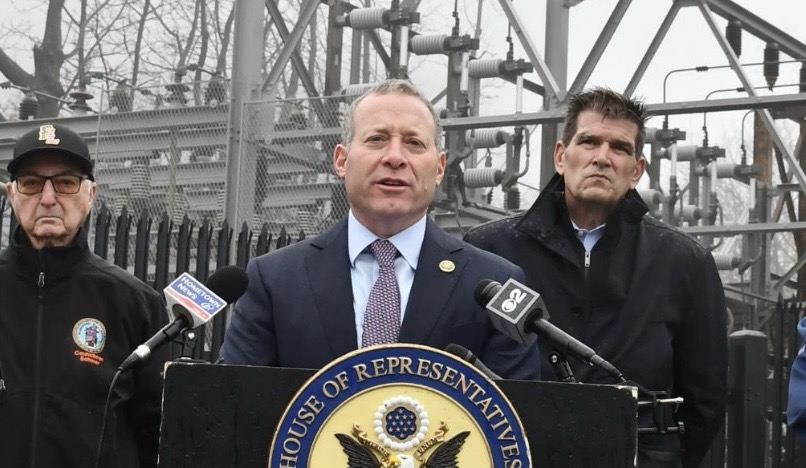
Above: Gottheimer announces federal actions to lower utility costs.
FORT LEE, NJ — Today, U.S. Congressman Josh Gottheimer (NJ-5) announced a comprehensive plan to increase energy production, modernize the grid, and reduce rising electricity costs for New Jersey families and small businesses. The announcement comes as utility bills across the state have surged by roughly 45 percent in the last two years, putting additional pressure on household budgets.
Watch Gottheimer’s announcement here.
Speaking in Fort Lee alongside labor leaders and local officials, Gottheimer laid out an “all-of-the-above” energy strategy aimed at strengthening supply, accelerating new projects, and ensuring New Jersey remains competitive for the jobs of the future.
“Energy isn’t a luxury — it’s a necessity,” said Congressman Josh Gottheimer (NJ-5). “Nobody in this state should be sweating over an electric bill at the kitchen table. We’re going to build more energy, cut red tape, hold the system accountable, and fight like hell to make sure Jersey families aren’t getting squeezed every time they flip on a light switch.”
Gottheimer continued, “In 1883, Roselle, New Jersey was the first town entirely in all of America lit by centralized power using overhead wires. And, today, we have places in Jersey that can’t get enough electricity to power a lightbulb.” …
“The reality is that energy demand has shot up nearly ten percent over the last five years, and it’s set to rise even more – by 25 percent – by 2030. And, the AI revolution is only just beginning, and it will continue to have a dramatic impact on the energy we’ll need for our universities, government, and all the jobs of tomorrow, including all of those great labor jobs. All of those data centers today will open up a host of new doors we haven’t even thought of – and they’ll take energy.” …
“Over the last eight years, New Jersey’s grid lost about 1500 megawatts – that’s enough for about 1.2 million homes, or the number of homes in Bergen, Essex, and Hudson Counties combined. Every shovel kept out of the ground – and every plant that we haven’t built – has driven up your rates. It’s a simple supply and demand problem.”
Gottheimer concluded, “One other thing: it’s a false assumption to say that the U.S. has to sacrifice longer-term climate goals if we take an all-of-the-above energy approach domestically. We can do both – and get energy prices down. We can have nuclear, natural gas – and alternative energies.”
Demand for electricity in the region has grown rapidly, driven in part by new technologies like artificial intelligence and data centers, while New Jersey’s grid has lost roughly 1,500 megawatts of capacity over the last eight years — enough energy to power about 1.2 million homes.
To address the growing gap between supply and demand and bring down costs, Gottheimer outlined six key steps:
As part of the plan, Gottheimer highlighted several pieces of bipartisan legislation he is advancing alongside Rep. Mike Lawler (NY-17) to modernize energy infrastructure, speed up projects, and bring down costs:
“For too long, critical energy projects in the United States have been delayed for years by bureaucratic red tape and bad-faith lawsuits that do nothing but stall progress. The Making Reviews Certain Act, the Grid Expansion and Reliability Act, the Commonsense Review Act, and the Build More Power Act are commonsense reforms that will help modernize our permitting process, strengthen our electric grid, and expand reliable domestic energy production,” said Congressman Mike Lawler (NY-17). “=These bills will cut unnecessary delays, encourage responsible infrastructure development, and help bring down energy costs for American families.”
Gottheimer emphasized the need to ensure that major technology companies help shoulder the cost of powering new data centers rather than passing those costs on to families and small businesses.
Gottheimer also announced he will convene utilities, regulators, energy producers, and federal agencies in the coming weeks to develop a coordinated strategy to expand energy production and strengthen the region’s grid.
Gottheimer was joined by Bergen County Commissioner and IBEW 164 President Tom Sullivan, Fort Lee Mayor Mark Sokolich, Fort Lee Councilman Harvey Sohmer, and IBEW 164 Business Agent Vincent Colucci.
Gottheimer’s full remarks as prepared for delivery can be found here:
Let me start with something every family in Jersey knows all too well. You open your electric bill. You look at the number. You blink once. Maybe twice. And then you say, “You’ve gotta be kidding me.”
For too many families in our state, that electric bill means making a tough choice. It’s either food on the table, a car payment, or keeping the lights on. That’s not right. And, it’s not because Jersey families did anything wrong.
Utility bills in New Jersey have surged 45 percent in just the last two years. Yes, 45 percent – and, they’re set to go even higher. And, by the way, that doesn’t account for gas prices at the pump, which, since the conflict in Iran, have surged 25 percent in the last two weeks, and are headed even higher. That’s not just more pain at the pump, but will also lead to higher prices in nearly everything you pay for, from groceries, to nearly everything in your Amazon packages.
Everywhere I go, folks are asking me the same question: how did my utility bills get so expensive? Nancy from River Vale told me that her monthly electric bill shot up by more than $320. Beverly from Washington Township saw hers go up by nearly $200. And, Thom from Waldwick kept his house at 66 degrees all winter, just to save money.
Let me be clear about something: energy isn’t a luxury. It’s a necessity. And, families shouldn’t be punished just for keeping the lights on.
New Jersey already has one of the highest costs of living in the country. We pay more for housing and child care. We pay more in property and income taxes. We pay more for food. The last thing we need is a broken energy system jacking up our utility bills even higher. But, right now, that’s exactly what we’re looking at. Today, I want to talk about steps to produce more energy to get your utility bills down and ensure Jersey can compete for the jobs of the future.
This issue really comes down to six things.
First, we’re just not producing enough power in our state. We must add more capacity and do it right away.
We all know this: With AI power demands staring us in the face, and nearly everything we use, from our phones to our cars, to everything you plug in these days, we need more electricity for everything across the board.
While demand has gone up, supply has not kept pace. A few years ago, we set a very big goal for ourselves in New Jersey – zero emissions by 2035. Now, I love when we set big goals and shoot for the moon. That’s literally how we sent men into space. Look, I’d love to get us off of fossil fuels today or next week and speed up our transition to alternative energies like solar. But, we didn’t leave much room for reality. We thought that our energy demand would continue to stay flat as it has for decades – or that our transition to more electric devices wouldn’t suck up that much supply.
The reality is that energy demand has shot up nearly ten percent over the last five years, and it’s set to rise even more – by 25 percent – by 2030. And, the AI revolution is only just beginning, and it will continue to have a dramatic impact on the energy we’ll need for our universities, government, and all the jobs of tomorrow, including all of those great labor jobs. All of those data centers today will open up a host of new doors we haven’t even thought of – and they’ll take energy.
So, when we set that big goal of transitioning to alternative energy, I fear we didn’t fully understand what was coming at us at the time. Plus, as we chased alternative energy, and demands soared, we cut off traditional supplies, and froze off all new capacity – no new plants, no major grid upgrades. When nuclear and gas plants closed across Jersey, we didn’t replace them with anything new. We shut down capacity, including the Oyster Creek Nuclear Plant and the Essex Generating Station. We failed to upgrade places like the Sewaren Plant in Woodbridge and the Kearney Generating Station. In 2022 alone, natural gas plants in Edison, Essex, and Newark all retired without a viable replacement – that’s enough energy to power roughly 120,000 homes.
Now, we made some great bets on solar energy. Thanks to legislation we passed and leadership here in our state, New Jersey is one of the top solar producing states in the country. Our wind bet didn’t pan out for a host of reasons, including President Trump’s recent decision to axe all wind projects. But, we just haven’t built enough to replace the energy we’ve lost, or to meet the growing demands – and we haven’t developed or updated the infrastructure to transmit all of that energy. At the same time, our next door neighbors, like Pennsylvania, surged their capacity, thanks to their shale, and, instead of joining them, and piping some of their natural gas capacity to us, we basically put up a wall.
Over the last eight years, New Jersey’s grid lost about 1500 megawatts – that’s enough for about 1.2 million homes, or the number of homes in Bergen, Essex, Passaic, and Hudson Counties combined. Every shovel kept out of the ground – and every plant that we haven’t built – has driven up your rates. It’s a simple supply and demand problem.
We missed opportunities to convert old coal plants to cleaner natural gas. We took nuclear offline. Didn’t add natural gas plants. We didn’t build enough new, modern transmission, and we’re still not managing our existing grid effectively.
Oh, and the consortium we rely on for our regional energy supply, PJM, is also getting crushed by demand and a lack of supply, because they also failed to build enough to keep up, and now they’re paying a fortune more for energy. Their wholesale prices over the last year went up by fifty-four percent, which means you have higher electric bills.
In the end, over the last decade, Jersey went from being a net exporter of energy to a net importer. This isn’t exactly a recipe for lower utility bills, or to keep and attract jobs of the future, or to beat other states with much more affordable energy.
Instead of taking an all-of-the-above approach, we ended up with a none-or one-of-the-above approach to energy supply, and now our families, small businesses, and workers are paying the price.
It’s nuts to me that we are now importing dirty coal energy produced from West Virginia and that we have brownouts during the summer months because we don’t have enough supply in Jersey. What’s particularly nuts about this is that Thomas Edison literally invented the light bulb here in our state. In 1883, Roselle, New Jersey was the first town entirely in all of America lit by centralized power using overhead wires. And, today, we have places in Jersey that can’t get enough electricity to power a lightbulb. That’s bananas. Do we want Jersey to be a part of that future, or be relegated to the past?
Or do we want to win and have jobs for our kids, and ensure that our grandparents can afford to stay here?
One other thing: it’s a false assumption to say that the U.S. has to sacrifice longer-term climate goals if we take an all-of-the-above energy approach domestically. We can do both – and get energy prices down. We can have nuclear, natural gas – and alternative energies.
President Obama called natural gas a “bridge fuel.” Twenty-five years ago, coal fired generation represented fifty-two percent of U.S. electric generation, and natural gas was only fifteen percent. Today, natural gas accounts for approximately forty-three percent with coal at fifteen — and renewable energy representing the difference. The result? The U.S. is at the lowest carbon emissions level nearly thirty years. We have to keep aiming higher, including here in our state. But, that can’t come at the cost of producing enough cleaner energy. We can’t go back to coal from West Virginia.
That’s why, at all levels of government, we must immediately work on a plan with our utility companies, the Board of Public Utilities, PJM, FERC, DOE, alternative energy producers, and experts, to build more natural gas, nuclear, and solar plants, hydroelectric facilities, and geothermal production. We need more modern infrastructure involving transmission, and we need to be smarter about how we are managing our grid. In the coming weeks, I’m planning to convene this broader group — a new, “More Energy, Lower Bills” Task Force — to make sure we’re doing everything possible in Washington to accomplish these goals.
Keep in mind that if we hit go today, gas plants, given the demand and long lead times for turbines, will take about four years to actually build. And, that’s presuming we can get in line fast and cut through the Jersey and U.S.-famous red tape for permitting. Nuclear energy will take us at least eight years to build. We should also focus on SMR – the smaller nuclear reactors, which take fewer years to build, but are still a few years from prime time.
At the same time, we must also push our solar companies to get more solar farms in the ground – on warehouse roofs, and in communities, and incentivize them in any way possible.
We should also focus on other alternative energies, like the Linden Renewable Energy Project in Elizabeth, that’s turning trash, real time, into power. We need to continue to invest in batteries, so that we can use stored solar power at night, not just when the sun is shining. We shouldn’t give up on wind either, but it has to be done the right way – far off of the Jersey shore, domestically built, and less expensive. There are also those other new renewable technologies like hydroelectric facilities and geothermal production.
Right now, we are staring down the barrel of the future. We will need an all-hands-on-deck to get this done.
To help get there, we will need to cut the insane amount of red tape, in Washington and Jersey, that’s in the way of building more new energy capacity. We need permitting reform.
Projects get stuck in years of reviews. Then come the lawsuits. Then more delays. And, by the time a project finally gets approved – if it ever does – the costs have exploded. Delays cost money, and they’re reaching into your family’s pockets to pay for it.
If we want lower bills, we’ve got to get good projects moving, and moving fast.
So, as part of my second solution, we need some serious permitting reform here in Jersey and in Washington. That’s why, I’ve been working with a group of Democrats and Republicans — in the House and Senate — on a new federal legislative framework to do just that – a comprehensive permitting reform bill that will help us build new energy plants faster, including traditional and alternative energy, allow for more interstate connectivity and transmission, prevent nonsense lawsuits, digitize the process, and keep projects moving.
It’s all about certainty. Cancellations discourage companies and utilities from wanting to build new plants. Under Biden, it was the Keystone Pipeline. Under Trump, it’s been wind projects, electric vehicle projects, and solar. Both sides keep going back and forth and we’re paying the price because no one wants to build in that environment.
PJM’s Surry-Skiffes Creek-Whealton transmission line project in Virginia took an additional three years for approval because of all the lawsuits, ballooning project costs by about $300 million. They came in last minute and revoked permits, setting it back big time. Our broken regional system and counterproductive state laws have delayed and killed potential expansion projects in Jersey.
So, I’m working on new bipartisan federal legislation called the “Making Reviews Certain Act” to reform NEPA’s judicial process – to gives courts a fast way to dismiss bad-faith lawsuits and let good-faith projects move forward.
We also need faster approvals for projects that already meet the rules. Outdated and overly burdensome regulations means operators and builders aren’t investing in Jersey. Instead, they’re pulling a “Reverse Washington” and crossing the Delaware to Pennsylvania, where the regulations are less burdensome.
I’m also introducing new bipartisan legislation called the Grid Expansion and Reliability Act to create a self-certification system for transmission projects, if they are built within an emergency-designated corridor.
When a project already meets strict safety and environmental standards, it shouldn’t sit around for years waiting for paperwork, especially if will be built in an area that badly needs it – and we have plenty of those in Jersey. We should allow for projects to certify they meet pre-set rules and then enforce accountability with audits and serious penalties if anyone abuses the system.
Third, as I said, we need to fix our broken regional power system, PJM, which is shared by thirteen states from North Carolina to Indiana.
Our power companies, like PSE&G, JCP&L, and Orange & Rockland buy their power from PJM – and they deliver it on their wires to your home.
It’s fair to say that for the last several years, PJM has been in total chaos. Their capacity auctions, originally designed to keep the grid reliable, are driving record-high prices. Those costs come straight out of your pocket and hit your monthly bills. That’s a huge part of the 45 percent increase families have seen.
I supported the inclusion of a “price collar,” which sets minimum and maximum prices that can be charged for the energy, and I was happy to see PJM extend it. Without those limits, last year’s bills could have been even higher. But, let’s be honest: this system needs a permanent solution, not just a temporary band-aid. We need more affordable long-term supply.
PJM has to actually follow through on its recent proposal, spurred by the demands of Northeastern Governors, to hold an emergency power auction and make technology giants pay for the surging power costs from new data centers, limiting the strain on family budgets. And, PJM needs to upgrade their grid, utilizing resources from the Bipartisan Infrastructure Bill that I helped write, negotiate, and pass. Our power companies also need to manage our grids more effectively.
I’ve also demanded answers from PJM, which is why I’m writing to them again, urging them to incentivize data centers to bring their own power online, so you’re not paying the price on your bills — and why I’m stressing the importance of demand forecasting, so that they are only procuring capacity for real and verified demand.
I also want to understand why new power plants and other forms of generation aren’t coming online faster? And what’s being done to keep prices down longer-term?
Families shouldn’t pay for mismanagement, and there are resources out there now to quickly deliver real relief, especially with all of the emerging technologies.
Data centers use massive amounts of electricity. Massive. Families in Paramus, Fort Lee, and Hackensack shouldn’t be subsidizing Big Tech’s power bills.
That’s why I support efforts by companies like Microsoft and OpenAI to step up, add more power, so that your bills don’t go up.
Microsoft is committing to pay utility rates high enough to cover its own energy costs. They are also working with utilities to add the power generation needed to power their data centers. OpenAI has committed to do the same. All of the AI platforms need to follow suit. The AI platforms – the hyperscalers – should be footing the bill.
PJM also needs to manage existing data center demand better – hyperscalers should be flexible with their demand. Even just a little bit of flexibility can put a lot less strain on the grid.
Fourth, we need to get our local, state, and federal agencies to work together, so that projects don’t get tied up for no reason.
Adding new power plants won’t help if the electricity they generate can’t actually reach your home or small business. We need better transmission.
If we’re building new power along existing roads, pipelines, or utility corridors – previously torn up land – the government shouldn’t be tripping over itself to stop it, and create layers of bureaucracy at the town, county, state, and federal levels. We don’t need review after review of the same project. Yes, we must protect the environment and public safety, but we shouldn’t create more red tape for the sake of some bureaucrat wanting their turn to flex.
We need categorical exemptions for projects in commonsense locations, and my new bipartisan legislation, the Commonsense Review Act, will require agencies including DOE, USDA, DOI, and FERC to work together to streamline the building process.
Fifth, we need to take steps to convert expensive, aging coal plants to more efficient, less costly natural gas and renewables. As it stands, the Trump Administration has required some of these out-of-date plants to continue operating, despite the fact that they are expensive and inefficient.
My new bipartisan legislation, the Build More Power Act, will require that when DOE demands that these aging facilities to stay open, they can use existing Inflation Reduction Act funding to convert them to natural gas or renewable energy. We can’t afford to let energy resources go offline, especially in the PJM region where we desperately need it. But, we need to do everything we can to upgrade these facilities, so that they run cleaner, faster, and cheaper. We can do this right now at the Eddystone Generating Station in Pennsylvania, a coal plant in the PJM region that’s being forced to run and is directly costing Jersey families.
Finally, while we are doing things to make energy more affordable, we need to use every resource available to get utility bills down right now. That includes ensuring Jersey families who qualify take advantage of programs like LIHEAP that subsidizes heating and cooling bills. LIHEAP provides families with hundreds of dollars per year, but only about 20 percent of eligible households in our state are actually receiving that assistance.
There are also state-level programs that subsidize renewable energy upgrades to homes through tax exemptions for adding things like solar or heat pumps to power your home, which can save families money on utilities over time.
I’m sending a letter to the National Governors Association pushing for states across the country to improve outreach and partner directly with utilities to enroll eligible customers. If a family qualifies, they shouldn’t have to jump through hoops to get help.
To supplement LIHEAP, I also introduced the Energy Costs Relief Act earlier this Congress, which would provide a refundable tax credit of up to $350 to help offset rising energy costs and put money directly back into the pockets of hardworking families.
In the end, as I hope you can tell, this isn’t about choosing between lower prices and reliable power. This isn’t choosing between protecting the environment and protecting your wallets. We can have both. And we should keep politics out of it.
We can lower utility bills, maintain reliability, and build cleaner energy. But, what’s clear is that we can’t sit on the sidelines and hope that more power will come online by itself to meet the massive amount of demand coming our way.
This is about making sure every New Jersey family can afford to live, work, and thrive not just today, but in the AI world of the future, when our schools, hospitals, businesses, and government will be utilizing it.
We’re going to build more energy. We’re going to cut red tape. We’re going to hold the system accountable. And we’re going to fight like hell to make sure Jersey families aren’t getting squeezed every time they flip on a light switch. Nobody in this state should be sweating over an electric bill at the kitchen table.
By working together, I know that here in the greatest country in the world, our best days will always be ahead of us. Thank you, and may God bless you, and may God bless the United States of America.
###