Oct 15, 2026
Press
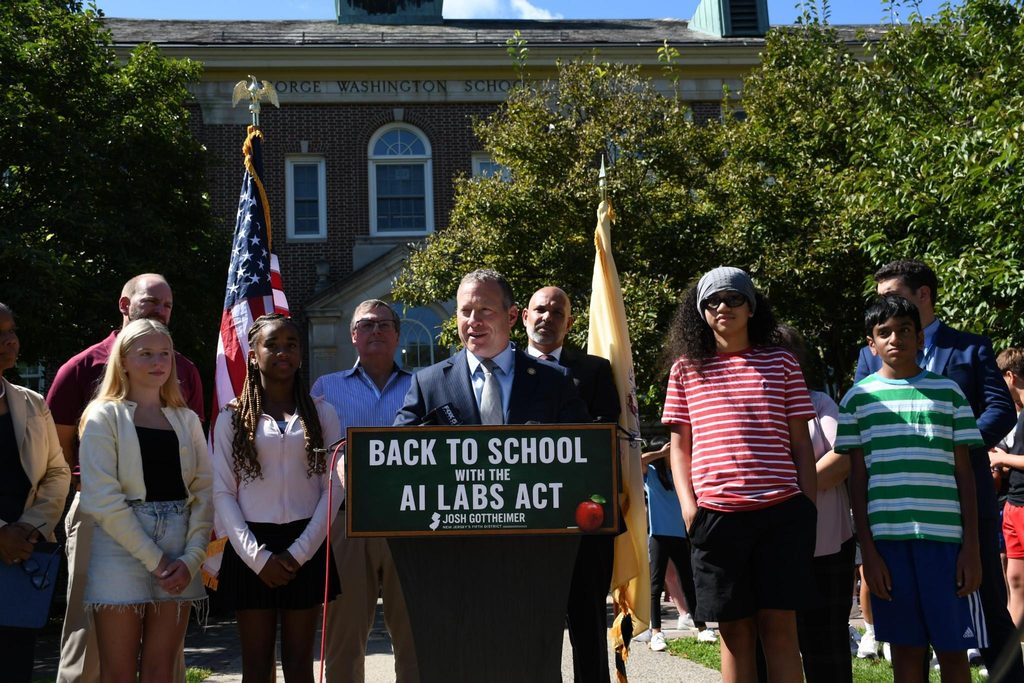
Above: Gottheimer announces Bipartisan Back-to-School Agenda on AI and Screen Time in K-12 Education.
RIDGEWOOD, N.J. — Today, September 4, 2026, U.S. Congressman Josh Gottheimer (NJ-5), Co-Chair of the House Commission on Artificial Intelligence and the Innovation Economy, unveiled a comprehensive, bipartisan back-to-school agenda to make sure students in the Fifth District and across the country are prepared for a world increasingly shaped by AI. Speaking at George Washington Middle School, Gottheimer announced his new bipartisan AI LABS Act, co-led by Congressman Jay Obernolte (CA-23), to help K-12 schools build dedicated AI labs and train teachers — and paired it with a broader push to keep phones out of the classroom, protect New Jersey’s phone-free schools resources, boost AI literacy in the classroom, and close the digital divide so no community gets left offline.
Watch full remarks here.
“We’re not going to pretend AI doesn’t exist, and we’re not going to ban it and hope it goes away. So, here in Jersey, we need to do this differently,” said Congressman Josh Gottheimer (NJ-5). “AI can be a powerful tool, but it can never replace the fundamentals. Give our schools the tools. Give our teachers the training. And give our children a real head start, instead of a false choice between banning technology outright and drowning in it.”
Gottheimer continued, “We can’t let AI write our papers or do our math assignments, but it can be a tool for helping us learn. We can’t allow AI to replace our educators, but it can certainly help take the busy work off their plate, or allow them to develop more personalized lesson plans for students. Our students need to learn how to think, solve problems, ask questions, and understand the material for themselves, not through a chatbot. We should use AI to strengthen those skills – not use it as a shortcut around them.”
AI is already reshaping how students study, how teachers plan, and how employers hire, but K-12 schools have unequal access to the tools and curricula students need to learn how to use it responsibly. The bipartisan AI LABS Act tackles that gap head-on.
This legislation directs the Department of Education to create a new federal grant program or make resources from existing grant programs available to help K-12 schools establish dedicated AI labs, much like the computer and typing labs that became a fixture in schools a generation ago. Those labs would give students hands-on curricula on how to use and understand AI, help teachers better understand the technology, and incorporate it into their classrooms. The bill also directs the Department to study who receives the resources, how they are used, and to make recommendations on future investment so students and educators stay ahead on AI education.
Alongside the AI LABS Act, Gottheimer announced additional steps in his AI back-to-school agenda:
These actions build on Gottheimer’s consistent support for New Jersey schools, including fighting against the Trump administration’s proposed cuts to over $1 billion in education funding for New Jersey, which were fortunately blocked.
Ridgewood Public School District, one of the largest and top-ranked school districts in Bergen County, is implementing a “Return to a Strong Foundation” emphasis this year focused on limiting screens in the classroom and keeping fundamentals front and center in the age of AI.
Gottheimer was joined by Ridgewood Councilman Frank Mortimer, Ridgewood School District Superintendent Dr. Mark Schwarz, George Washington Middle School Principal Dave Bailey, Bergen County Association of School Administrators President Dr. Joseph Cirillo, NJ PTA President Jackie Gibbs, NJ PTA Federal Legislative Chairperson Sharon Roseboro, and NJ PTA Bergen County Council of PTAs President Nancy Wallace. Gottheimer was also joined by four George Washington Middle School students involved in student government – Alaiya Barnes, Landon Ponchak, Karleigh Cadaret, and Druv Kethini.
Below: Gottheimer announces Bipartisan Back-to-School Agenda on AI and Screen Time in K-12 Education.
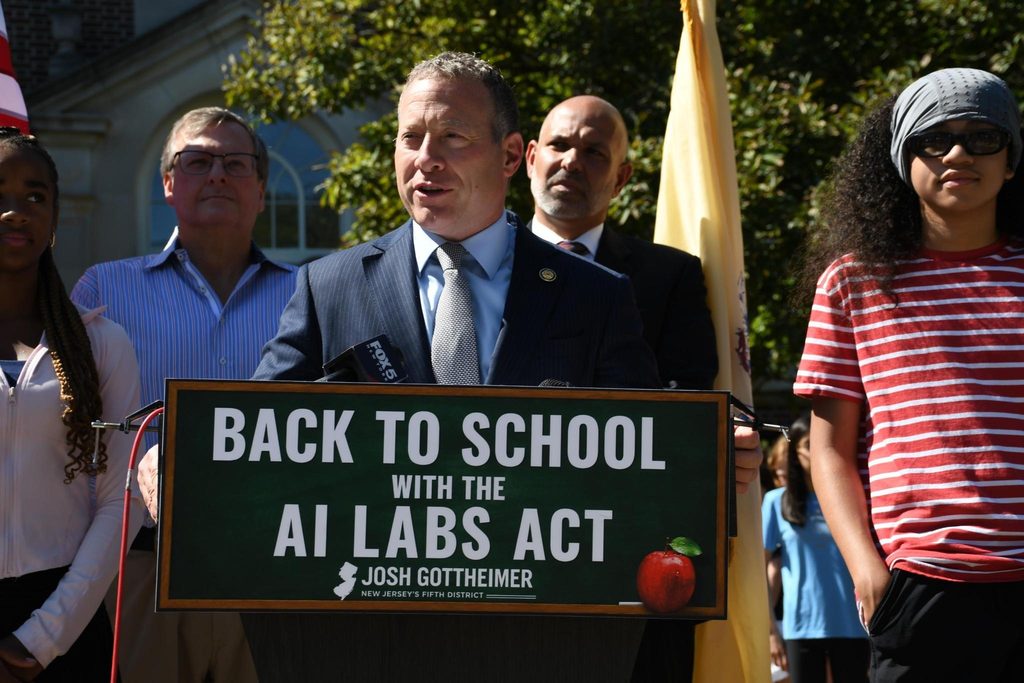
Read full remarks here:
Good morning, Ridgewood!
As you close out your first week back to school, I want to start by thanking everyone here at George Washington Middle School, including the educators, the administrators and staff, the school board, and especially the students, for having me here today.
Now, I did a little homework before I came, because that’s what you’re supposed to do at school, right? And, I learned a couple of things about this building that I did not know.
First, some of you know the name Willie Geist. He anchors Sunday Today and co-hosts Morning Joe. Willie met his wife, Christina, in their sixth-grade homeroom right here at George Washington Middle School, back in 1986. Forty years later, they’re still together. So, I don’t know exactly what they were teaching in that homeroom, but whatever it was, keep doing it.
Second, Ridgewood’s roots go all the way to the Revolutionary War. George Washington visited this area and wrote letters from right around here, while Patriot and British troops fought nearby. The borough was practically founded during America’s fight for independence. When Washington delivered his first Annual Address to Congress, he said something I think about a lot, especially on a day like today. He said, “Knowledge is in every country the surest basis of public happiness.”
Two hundred and fifty years after our founding, that’s still true, and it’s exactly why we’re here this morning.
I want to give real credit to the Ridgewood School District. While you study the past, you’re not living it. You’re on the cutting edge of education, including how to best use, and not use, technology to learn. This year, you launched your “Return to a Strong Foundation” initiative, cutting back laptop use in the classroom for its nearly 5,500 students, especially for the youngest children. Ridgewood started limiting cell phones in school, too, with phones in lockers, all day, for every student, from elementary school right up through high school. I should add that’s now the state law. No phones in the classroom.
In my opinion, that’s exactly the kind of commonsense, community-driven leadership we need more of, and it’s exactly the balance we need to be talking about in the age of AI. The answer isn’t more screens. The answer is smarter, more purposeful use of technology, alongside real, honest-to-goodness reading, writing, and critical thinking. In other words, technology can’t do your work or your thinking for you. When the calculator showed up to replace the abacus, we still learned how to count. As a kid, I used to look up facts in the World Book Encyclopedia – and then came the Internet.
I still got to read about and learn about the landing on the moon, but I found the information online, not in a book on the shelf. There’s a big difference. We can’t let AI write our papers or do our math assignments, but it can be a tool for helping us learn. We can’t allow AI to replace our educators, but it can certainly help take the busy work off their plate, or allow them to develop more personalized lesson plans for students.
It’s clear that your school system and your educators already get that. Today, I’m here to take that approach across our state and nationwide.
We are at a true inflection point. Technology isn’t slowing down for us. It never has and never will. Just this week, OpenAI introduced Astra, its latest model. This is on the heels of Anthropic’s Mythos – and new Chinese open-weight models that are coming at us nearly every week.
Whether we like it or not, artificial intelligence, or AI, is already in our children’s backpacks, on their laptops, and on their phones. The question isn’t whether our children will encounter AI in their lives – K-12, in college, in their jobs. They will. Just the way we have iPhones and our parents didn’t.
The question is whether we prepare them for it, or just cross our fingers and hope for the best.
Obviously, we can’t take that chance. Our children absolutely need every tool available to compete, not just against others in New Jersey or in the US, but against children in China, India, and all over the world already being trained on this technology. If we sit on our hands, if we don’t have the tools, we will fall behind. That’s just the reality.
But, I want to be really clear about this. AI can be a powerful tool, but it can never replace the fundamentals.
Our students need to learn how to think, solve problems, ask questions, and understand the material for themselves, not through a chatbot. We should use AI to strengthen those skills – not use it as a shortcut around them.
Here’s why I say that. A recent poll found that 45 percent of Jersey students report using AI frequently for schoolwork. But, here’s the number that should get every parent’s attention: nearly two out of three students admit they’ve used AI to cheat in school. And nationally, the majority of teens think AI cheating happens regularly at their own school.
Meanwhile, a lot of parents are flying blind – and, while there are some tools to help, it’s not always easy for an educator to catch a kid using AI to do his or her assignment. In a recent survey from Montclair School District, half of parents said they had no idea how often their own kid uses AI for schoolwork, and 87 percent said they want clearer communication from schools about all of it. So, we’ve got children using a powerful new technology every single day, and we’ve got parents and teachers who, in far too many cases, don’t even know it’s happening, let alone whether it’s helping or hurting their student or child.
Now, some places have looked at all this and panicked. This week, Mayor Mamdani and New York City rolled out a policy banning AI tools outright for every student through eighth grade, with only high schoolers getting restricted access.
I get the instinct. Fewer screens, more critical thinking. I agree with that part, one hundred percent – and I think a lot more of our tests and note-taking should be on a piece of paper, not a computer. But, an outright ban doesn’t teach a single kid how to use AI responsibly, nor does it teach the skills that can help them.
It just guarantees that the first time they really encounter AI with no guardrails and no guidance is the day they get handed a diploma and shoved into a workforce that runs on this stuff. That’s not a plan. That’s sticking your head in the sand and hoping it goes away.
Think about it this way. When I was a kid, we had typing class. Some of you probably did too, pecking away on those big clunky keyboards.
Then by the 80s, and into the ’90s, schools built computer labs because people realized that if children don’t learn a new technology in school that would prepare them for life, in a structured way, with a teacher guiding them, they will learn it somewhere else: badly, unsupervised, and usually too late.
AI technology is the same idea for this generation. We’re not going to pretend it doesn’t exist, and we’re not going to ban it and hope it goes away. So, here in Jersey, we need to do this differently.
We should put AI skills in a classroom, with a curriculum, with an educator, and with guardrails, so that our children grow up to be smart users of AI, not passive victims of it.
That’s why, today, I’m announcing my new bipartisan AI LABS Act, with my colleague Congressman Jay Obernolte of California. This federal legislation directs the U.S. Department of Education to create a new federal grant program to help K-12 public schools set up dedicated AI labs, with real curricula, that teach students how AI actually works, and how to be prepared to utilize it smartly in the new AI world.
This builds on recommendations from the American Federation of Teachers and the National Education Association for real, dedicated curricula that are directed and supervised by educators. There is a reason why AI companies are now hiring college students with philosophy and history degrees, not just those with computer science degrees. They want people who can think critically. The trades also want young people who know how to use AI on the shop floor and in building and manufacturing.
That means learning how to use AI, how to question it, and how to know when to – and not to — trust it. My new legislation will also help teachers get trained up, too, so they’re not scrambling to keep pace with their own students. It also requires a study on how the funds are actually being utilized, so we know what’s working and can keep improving it.
I don’t want to raise a generation of children who can prompt a chatbot, but can’t write a paragraph on their own, or think through what question to ask the chatbot.
I want to raise a generation of children who can use it to genuinely improve their work, because they understand how to use it and know its limits.
That’s the whole idea behind the AI LABS Act. Give our schools the tools. Give our teachers the training. And give our children a real head start, instead of a false choice between banning technology outright and drowning in it.
Second, I’m sending a letter to Governor Sherrill and Education Commissioner Laux on the State’s Phone-Free Schools Grant Program. That program has already helped eighty-six school districts, including eleven right here in the Fifth District. It puts real bell-to-bell cell phone policies in place, with secure pouches, lockers, and the staff training to make it actually work.
Here’s the problem: The current budget for next year includes a record $12.4 billion for K-12 education, but there’s no dedicated earmark in there to keep this program going in the future.
My letter emphasizes the importance of this funding – school districts are just starting to get this right, and we can’t pull the rug out from under them now.
Third, I’m also pushing for new federal funding to help supplement the state’s program. That’s why, I’m very proud to cosponsor the bipartisan UNPLUGGED Act – legislation that directs states and school districts to actually implement phone-free policies during the school day, and it creates a federal grant program to help schools pay for the lockboxes and secure pouches to make it happen.
It includes sensible exceptions too, for children managing a medical condition like Type 1 diabetes, children with disabilities, and English language learners who need translation support.
More resources for this important effort will help implement New Jersey’s new cell phone ban legislation that previous Governor Murphy signed into law in January, which requires all school districts in the state to adopt policies restricting the use of cell phones and other internet-enabled devices in K-12 public schools.
Fourth, I’m working with the state to keep building out real K-12 AI literacy priorities. This builds on New Jersey’s Department of Education’s new core AI principles that were developed with TeachAI, a global partnership that helps schools and governments use AI safely and responsibly in education. These principles will ensure Jersey schools keep people in the loop and put students’ own thinking front and center, not just whatever the AI spits out. This is exactly the kind of approach we need.
We can’t risk losing funding for this program. That’s why, along with others, I successfully fought the Trump Administration’s proposed cuts to New Jersey’s schools. He tried to gut more than $1 billion in federal funding – and we beat him.
And finally, I’m writing to the FCC and the NTIA about broadband access and connectivity. This is an issue that I’ve been working on for years, and, while we’ve made a ton of progress, we still have towns in Northern Jersey with basically dial-up connectivity, and speeds that AI can’t run on. That’s unacceptable.
Right now, there are more than 5,000 homes in Sussex County without dial up, with more than 3,000 more who don’t have access to broadband.
If we don’t get high-speed internet into our rural and disadvantaged school districts, like parts of Sussex County that I represent — net inequality will be permanently baked in. The advantages that AI promises shouldn’t depend on your zip code. I am urging both agencies to prioritize the communities furthest behind, so they get connected first, not last.
This builds on my work getting hundreds of millions in funding for broadband infrastructure right here in Jersey through the American Rescue Plan, the Bipartisan Infrastructure Bill, and the CARES Act, three historic bills that I helped write, negotiate, and sign into law. I’m calling on the state to put to work the money that I fought for in the Care Act. New Jersey was approved for more than $260 million that I helped bring back from the Bipartisan Infrastructure Law. So far, only $60 million has been deployed to help connect Jersey families, but we have a long way to go.
Right now, the Trump administration is holding up the last $200 million of this critical funding to connect families across Sussex County and the rest of the state. That’s why the FCC and the administration need to release the rest of the funds and get broadband access to every family across the state.
Put it all together, and here’s what we’re doing today: a bill to teach AI the right way, and a push to keep phones out of the way, a push to get real funding for AI literacy, and a push to make sure no community in America gets left offline while the rest of the world races ahead.
I’ll be honest with you: as Co-chair of the House Commission on AI, technology is moving fast, and some days it can feel like it’s moving faster than we can keep up with. But, I have never once bet against American children and Jersey’s incredible educators and schools – and I’m not about to start today.
I promise you, these children will run circles around whatever the future throws at them.
As long as we keep investing in our children and working together, here in the greatest country in the world, I know that our best days will always, always be ahead of us.
Thank you, God bless you, and may God continue to bless and watch over the United States of America.
###